
William Morris Prints
The story behind Strawberry Thief, Kennet and Dove and Rose, and how to hang Morris patterns so a room feels rich, not busy.
Few designers have shaped the way we decorate as much as William Morris. More than 125 years after his death, his birds, vines and river patterns still cover sofas, notebooks and wallpaper rolls. They work because they were designed for living rooms, not galleries. Morris drew patterns to be lived with every day, so a framed Morris print feels at home almost anywhere.
This guide covers the designer, the patterns worth knowing and how they came about. It also gives practical rules for choosing sizes, frames and placement, with every measurement in inches and centimeters. You can browse the full range in our floral wall art collection.
Morris’s best-known line comes from his 1880 lecture “The Beauty of Life”: “Have nothing in your houses that you do not know to be useful, or believe to be beautiful.” It is still a good test for wall art. A Morris print earns its place by doing a job: it brings pattern, color and a little nature into a room that might otherwise feel flat.
Who was William Morris?
Morris was born on 24 March 1834 in Walthamstow, then a village in Essex, and died in Hammersmith, London, on 3 October 1896. In his lifetime he was best known as a poet. Today he is remembered mainly as a designer of wallpapers and fabrics and as a leading figure of the British Arts and Crafts movement.
His design career began at home. With his friend, the architect Philip Webb, he planned Red House in Bexleyheath, Kent, where he lived from 1859 to 1865. Furnishing it led to a decorative arts firm, founded in April 1861 with Edward Burne-Jones, Dante Gabriel Rossetti, Webb, Ford Madox Brown and others. The firm made stained glass, furniture, tapestries, textiles and wallpaper. Morris’s first wallpaper, Trellis, was designed in 1862. Over his career he produced more than 600 designs for wallpaper, textiles and embroidery.
Two places matter most for his patterns. In 1871 he took a joint tenancy on Kelmscott Manor, a house built around 1570 in rural Oxfordshire, on the upper Thames. Its garden and river gave him many of his motifs. In 1881 he leased the Merton Abbey works, a former silk-weaving site beside the River Wandle in south-west London. Within three years about 100 craftsmen worked there, weaving, dyeing and printing.
Five Morris designs worth living with
Strawberry Thief (1883)
This is the pattern most people picture when they hear “William Morris.” It shows the thrushes Morris caught stealing strawberries in the kitchen garden at Kelmscott Manor. He printed it at Merton Abbey with indigo discharge, a slow method he admired above all others: the cloth was dyed blue, then bleached and overprinted to bring in white, red and yellow. In May 1883 he wrote to his daughter that he was “anxiously superintending the first printing of the Strawberry thief.” It became one of his most expensive cottons and one of his best sellers.
At home, the deep indigo ground makes it a natural fit for navy, sage or warm white walls. Choose the vertical Strawberry Thief print for a narrow wall or a stair landing, or the horizontal Strawberry Thief above a sofa or a dining sideboard.

Strawberry Thief: blue ground, red fruit, and birds that bring movement to a quiet wall.
Kennet (1883)
In 1883 and 1884 Morris designed a series of indigo-printed fabrics named after tributaries of the Thames, including Kennet, Windrush, Evenlode, Wey and Wandle. Kennet is a flowing pattern of leaves and blossoms, again printed with indigo at Merton Abbey. Its long, wavy stems lead the eye upward, which makes it a good choice for tall, narrow spaces. Hang the Kennet (1883) print in a hallway, beside a door frame or between two windows.
Windrush (1883)
Named after the Windrush, another Thames tributary in Oxfordshire, this pattern packs leaves, flowers and branches into a dense, balanced surface. It is busier than Kennet, so it works best where it has some breathing room. The Windrush decorative print suits a reading corner or a bedroom wall with plain bedding and a solid headboard.
Dove and Rose (1879)
Dove and Rose began as a woven furnishing fabric, a double cloth of silk and wool. Pairs of birds sit among climbing roses in soft, muted tones. It is the gentlest of the classic designs, which makes the Dove and Rose (1879) print a strong candidate for a bedroom, a nursery or a guest room.

Dove and Rose: soft color and small motifs for restful rooms.
Honeysuckle, Vine and Wild Tulip
Morris’s botanical patterns are some of the easiest to live with because they read as greenery from across the room. The Honeysuckle print, the Vine print and the Wild Tulip print all lean on leaf greens, so they sit well with houseplants, wood furniture and linen.
Morris-inspired animal prints
Alongside the historical patterns, WallArtK offers a range of contemporary animal prints designed in the Morris tradition. These are new designs, not reproductions: a single animal set against dense vines, flowers and leaves in the Arts and Crafts manner. They are a good way to bring a personal touch to a classic look, for example a hare for a country kitchen or an owl for a study.
Start with the Morris-style hare print, the owl print or the sparrows print. For a pair, the kingfisher and robin set is ready-matched.
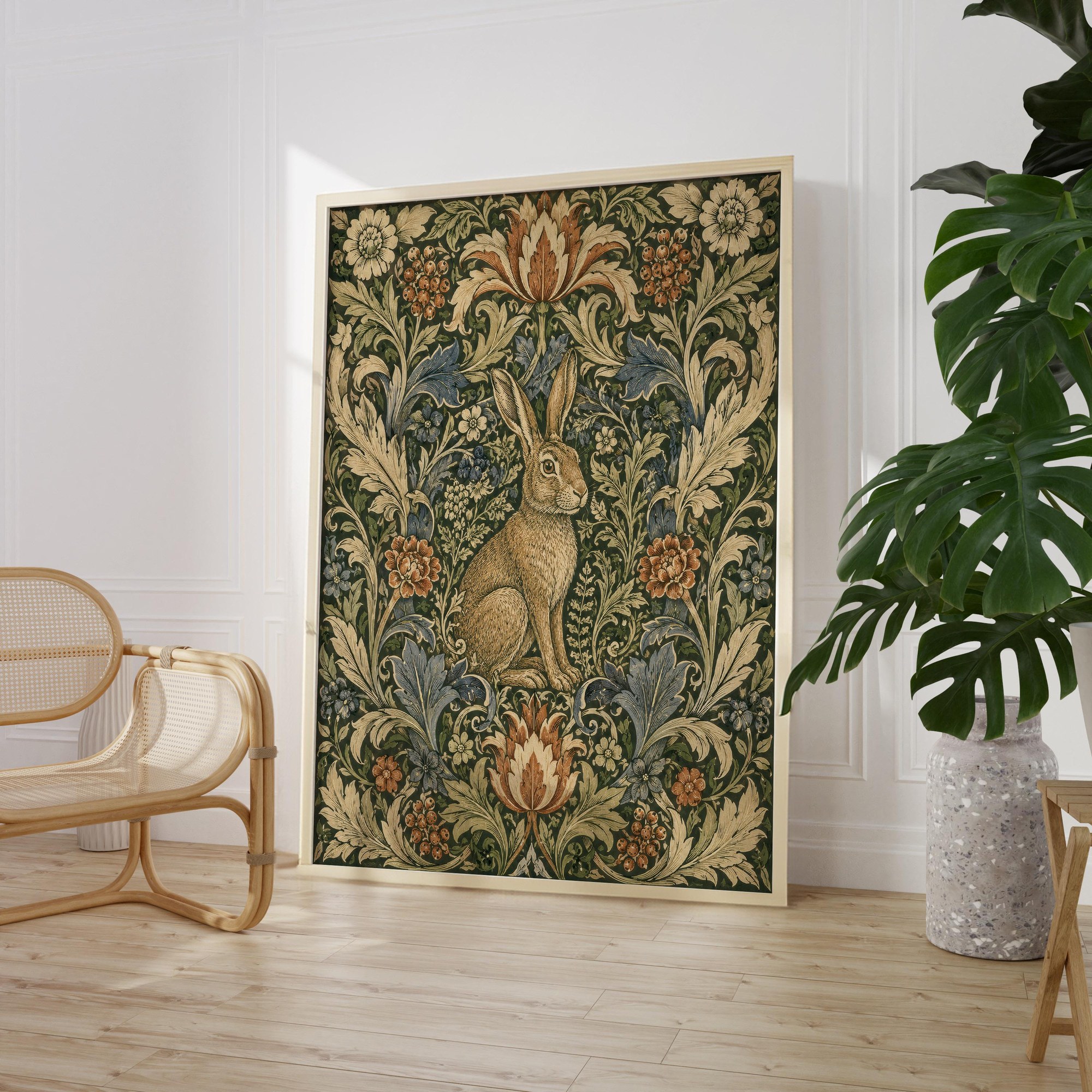
Morris-inspired animals: a personal twist on the classic patterns.
How to choose the right size
Pattern changes the size rules. A detailed Morris design reads as texture from a distance, so it needs enough size to show its motifs, but it also tires the eye faster than a calm landscape. These guidelines work in most homes:
- Above a sofa: aim for art about two thirds the width of the sofa. For a standard 84 in (213 cm) sofa, a single horizontal print of 30×40 in (75×100 cm) or a pair of 20×28 in (50×70 cm) prints works well.
- Above a bed: a pair of 18×24 in (45×60 cm) prints suits a queen bed (60 in / 152 cm wide). For a king, step up to 24×32 in (60×80 cm).
- Hallways and narrow walls: one vertical 16×20 in (40×50 cm) or 18×24 in (45×60 cm) print. Kennet’s upward flow suits this best.
- Kitchens, shelves and small nooks: 12×16 in (30×40 cm) is enough. The smallest 5×7 in (13×18 cm) size works on a desk or a bookshelf.
Our wall art size guide has more examples by room and furniture.
If your sofa, curtains or cushions already carry a Morris fabric, choose a print from a different design, or a plain botanical, for the same wall. Two different strong patterns side by side compete. One pattern plus calm surroundings looks deliberate.
Frames and wall colors
Every WallArtK print is a giclee on 250 gsm acid-free fine art matte paper, and you can order it framed in natural, dark, white or black wood with shatterproof plexiglass. Framed prints arrive ready to hang, with hanging hardware included.
- Natural wood is the most faithful to the Arts and Crafts spirit, which favored honest, simple materials. It suits the green botanicals and light rooms.
- Dark wood suits Strawberry Thief, Kennet and Windrush on deep walls: navy, forest green, oxblood. It gives a library or Victorian look.
- White keeps Dove and Rose light and modern in a white or pale grey bedroom.
- Black sharpens the contrast in a contemporary room and turns the pattern into a graphic statement.
For walls, Morris patterns sit well against colors pulled from the prints themselves: indigo, sage, olive, ochre and soft cream. Avoid bright white in a dim room; a warm off-white keeps the colors rich.
Placement and hanging
Hang the center of the artwork at about 57 to 60 in (145 to 152 cm) from the floor, the usual eye-level rule. Above furniture, leave 8 to 10 in (20 to 25 cm) between the top of the sofa or headboard and the bottom of the frame. In a pair, keep a gap of 2 to 4 in (5 to 10 cm) between frames so they read as one unit. Our guide on how to hang wall art covers tools and layouts step by step.
Building a Morris gallery wall
Morris prints are made for groupings because they share a palette. A simple recipe for a gallery wall:
- Pick one anchor: a large Strawberry Thief or Windrush, 24×32 in (60×80 cm) or bigger.
- Add two or three smaller botanicals, such as Vine, Honeysuckle or Wild Tulip, at 12×16 in (30×40 cm).
- Finish with one or two Morris-inspired animals to add a personal note.
- Keep the same frame color across the wall and the gaps even, about 2 to 3 in (5 to 8 cm).
Lay the frames out on the floor first, or trace them on paper and tape the shapes to the wall. Step-by-step layouts are in our complete gallery wall guide.
Room by room
Living room: one large dark-framed Strawberry Thief over the sofa, with plain cushions in indigo or rust. See more ideas in our living room wall art guide.
Bedroom: a pair of Dove and Rose or Honeysuckle prints in white or natural frames above the bed. More in our bedroom wall art ideas.
Kitchen and dining: Morris-inspired birds and hares at 12×16 in (30×40 cm), hung near open shelving. See our kitchen wall art guide.
Study or library: Kennet or Windrush in dark wood, set against a green or navy wall with brass lamps.
If you love flowers in art more broadly, our floral wall art guide covers painters from the Impressionists onward.
Bring a little Arts and Crafts pattern home: classic Morris designs and Morris-inspired animals, printed on fine art paper and ready to hang.