Winter Landscape Wall Art
Snow scenes by Kirchner, Munch, Malevich and Hartley, and how to hang them so a room feels calm, bright and warm all season.
Winter landscape wall art does something no other seasonal decor can: it brings light into a room just when the days are shortest. Snow is the brightest surface a painter can show, so a good snow scene works like a second window. And unlike garlands and ornaments, a winter landscape can stay up from November to March without looking like a holiday decoration.
This guide covers six modern painters who painted snow in very different ways, from Kirchner’s pink Alpine valleys to Malevich’s metallic cubist village. For each, you get the backstory and the room it suits best. After that come practical rules for sizes, frames and placement, with every measurement in inches and centimeters. You can browse the full range in our landscape wall art collection.
Snow simplifies a landscape. It hides clutter, flattens detail and leaves a few strong shapes: a roofline, a dark tree trunk, a road. That is why so many modern painters loved it. Snow already did half the work of abstraction for them. In a room, the same effect reads as quiet. A wall with one large snow scene usually feels more restful than a wall with several busy pictures.
Six winter paintings worth living with
Ernst Ludwig Kirchner: Davos in Snow (1923)
Kirchner was a founder of the Dresden group Die Brücke in 1905 and one of the loudest voices of German Expressionism. In 1917, ill and exhausted after the First World War, he moved to the mountains around Davos in Switzerland. He lived there until his death in 1938. The Alps changed his painting: city crowds gave way to farmhouses, peaks and the slow rhythm of the seasons. In autumn 1923 he settled in a house on the Wildboden, above Frauenkirch, and painted Davos again and again.
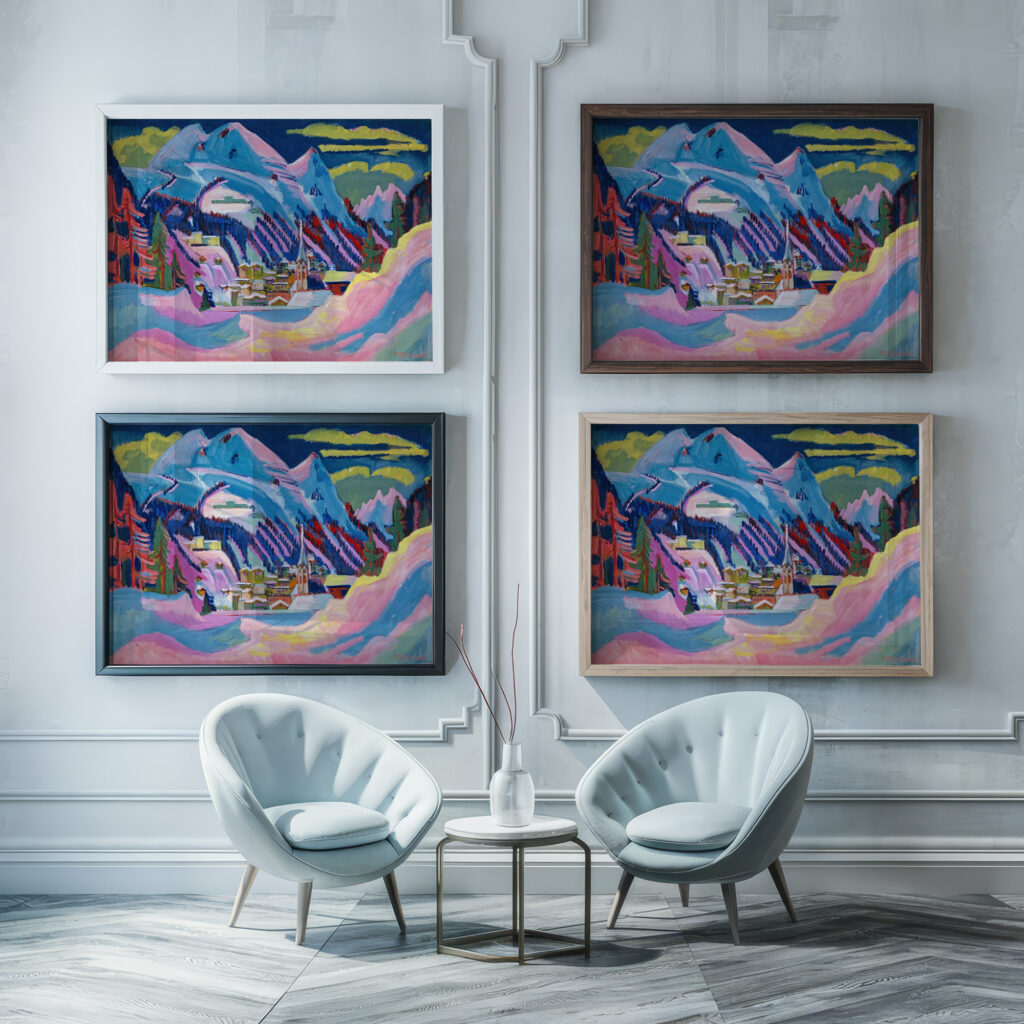
Davos in Winter. Davos in Snow (1923) shows the town tucked into a white valley under colored mountains. It is not a cold picture. The snow carries pinks and blues, and the buildings are stacked like toy blocks. It is a horizontal composition, so it suits the long wall above a sofa or a dining sideboard. Sizes run from 12×16 in / 30×40 cm up to 30×40 in / 75×100 cm.
For a second Kirchner, View of Davos (Landscape near Davos in Winter) (1925) pairs well in the same frame color.
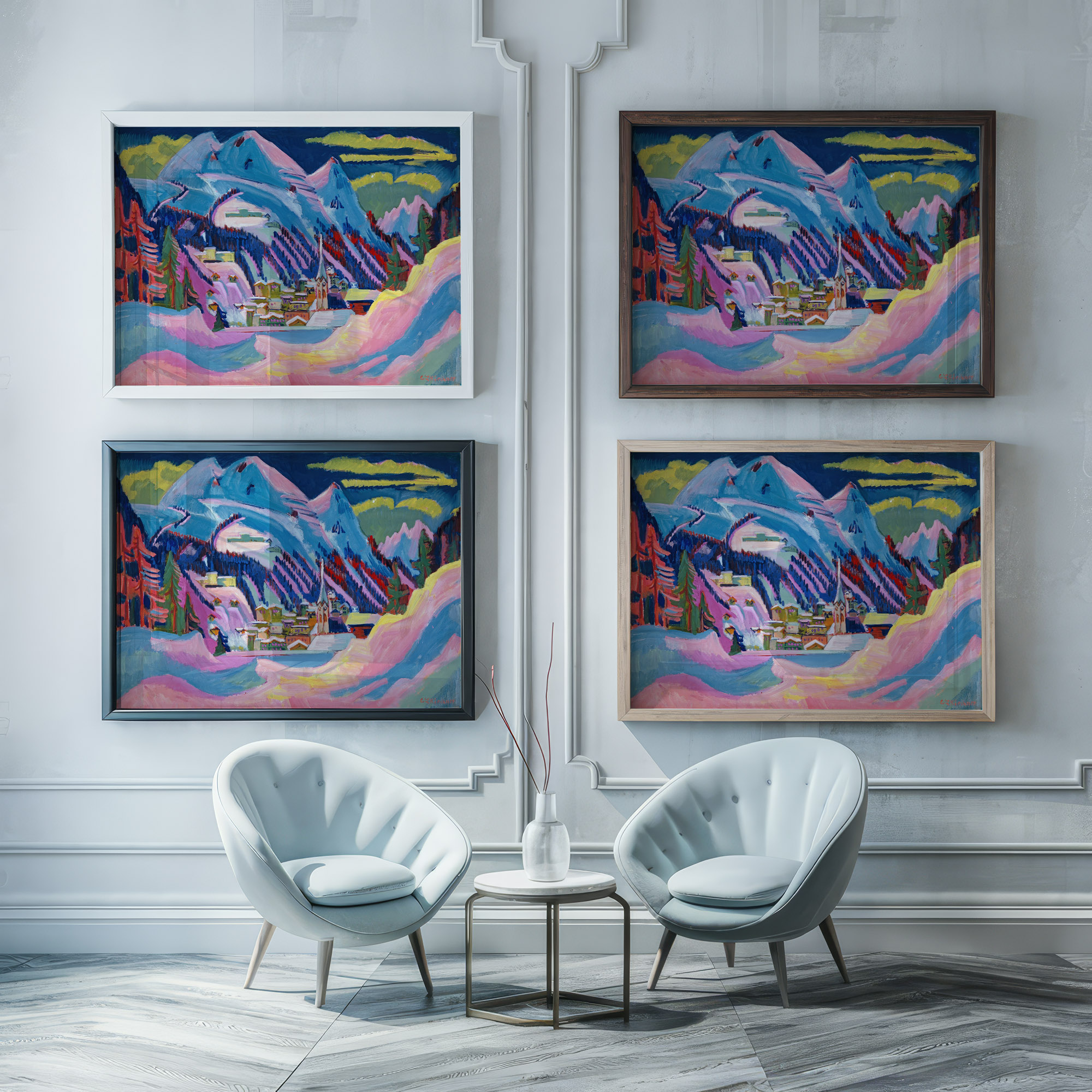
Kirchner’s Davos in Snow (1923): a warm-colored winter scene for a long living-room wall.
Kazimir Malevich: Morning in the Village after Snowstorm (1912)
Years before his Black Square of 1915, Malevich painted Russian peasant life in a style he called Cubo-Futurism. Morning in the Village after Snowstorm (1912) is one of its best-known examples. The original, oil on canvas about 31.5 x 31.5 in (80 x 80 cm), belongs to the Solomon R. Guggenheim Museum in New York. Villagers, houses and snowdrifts are built from shiny cones and cylinders in grey, white, red and blue. The result looks almost like metal.
The Malevich print keeps the original square format. It comes in 12×12 in / 30×30 cm, 20×20 in / 50×50 cm and 28×28 in / 70×70 cm. Square works are useful in tricky spots: between two windows, above a console, or centered over a nightstand. Its grey-and-white palette suits modern rooms with concrete, steel or black accents.
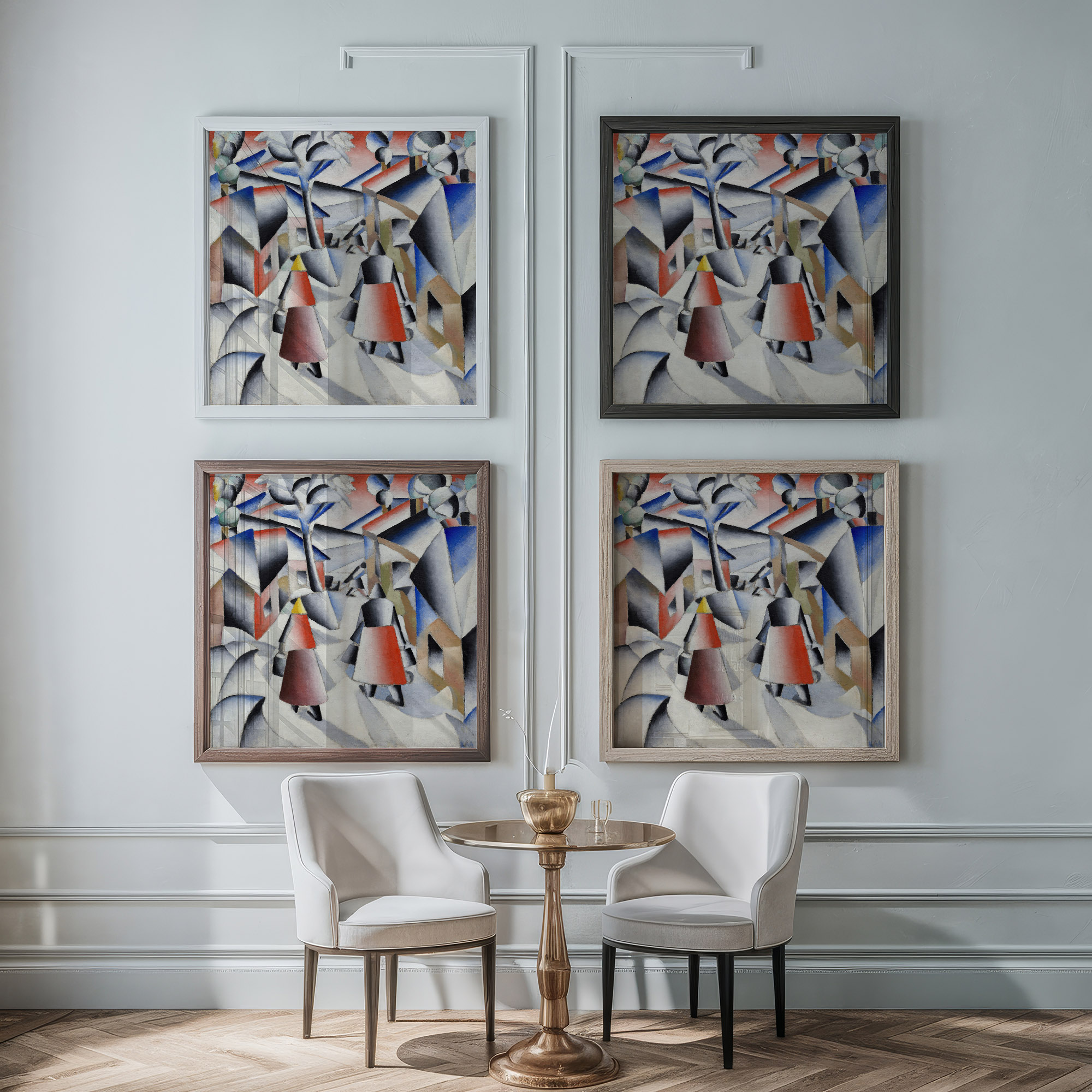
Malevich’s square snow scene fits narrow walls between windows or above a console.
Edvard Munch: snow on the Norwegian coast
Most people know Munch for The Scream, but he painted winter for decades. After treatment at a clinic in Copenhagen in 1908-09, he returned to Norway and rented a house called Skrubben at Kragerø on the south coast. Between 1909 and 1916 he painted many winter landscapes there, and the snowy hills fed into his large paintings for the University of Oslo’s Aula. In 1916 he bought the Ekely estate outside Oslo, where he kept painting snow-covered trees and gardens into old age.
Three WallArtK prints show this side of Munch. Snowstorm by the Sea (1910-12) is loose and windy, a good choice for a coastal house in the off season. Rugged Trunks in Snow (1923-25) sets dark pine trunks against white ground, a strong graphic image for a hallway or study. Field in Snow (1907) is the quietest of the three.
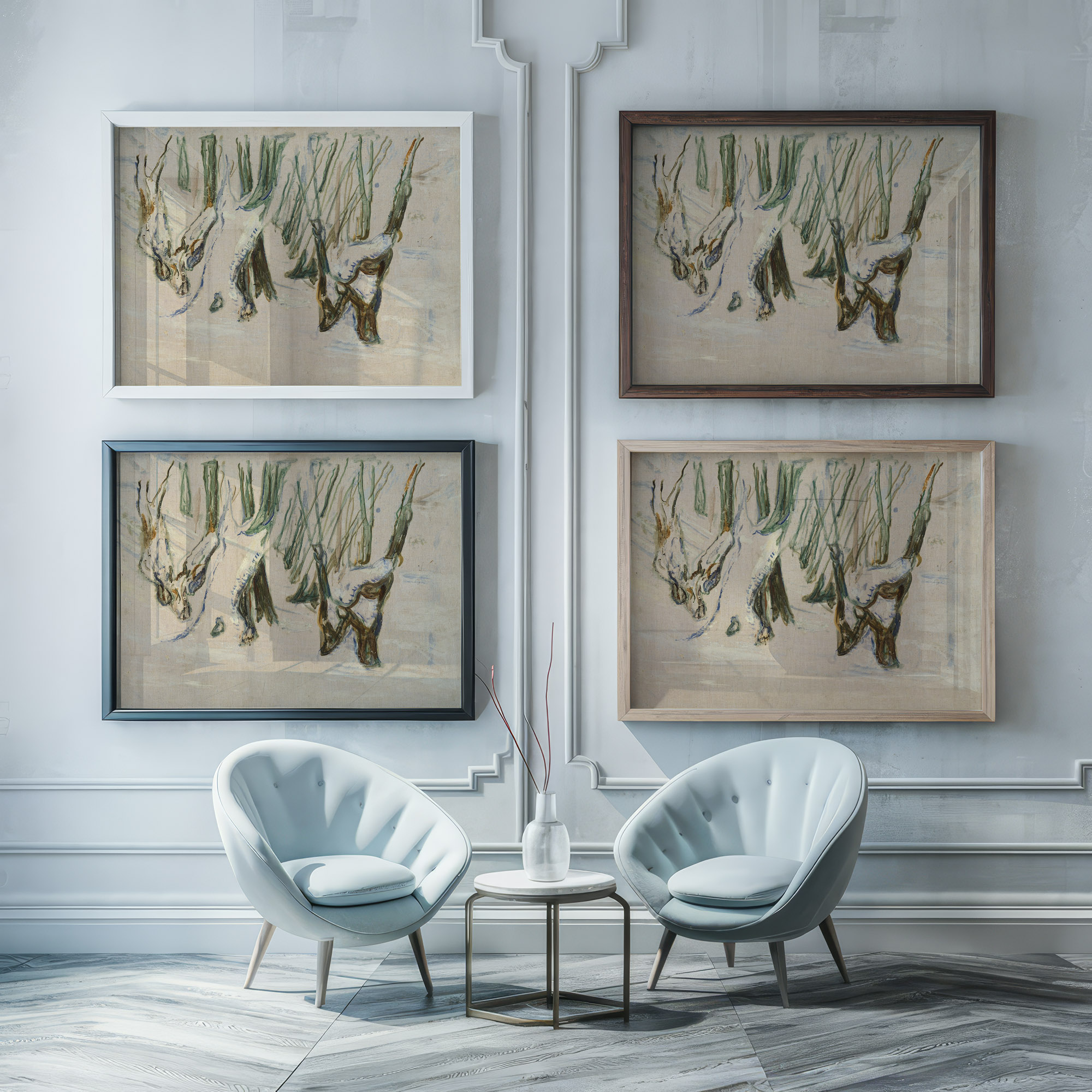
Munch’s Rugged Trunks in Snow: strong dark verticals that hold their own in a narrow hallway.
Marsden Hartley: Songs of Winter
Marsden Hartley was born in Lewiston, Maine, in 1877. Around 1907-08 he painted a series of small mountain pictures in Maine that he called Songs of Winter, using short, stitched strokes inspired by the Italian painter Giovanni Segantini. These paintings helped him win his first solo exhibition, at Alfred Stieglitz’s gallery 291 in New York in 1909, which launched his career.
Songs of Winter, No. 3 (circa 1907-08) has a textured, almost woven surface. It is a natural fit for cabins, reading corners and rooms with wool throws and natural wood, where its texture echoes the textiles around it.
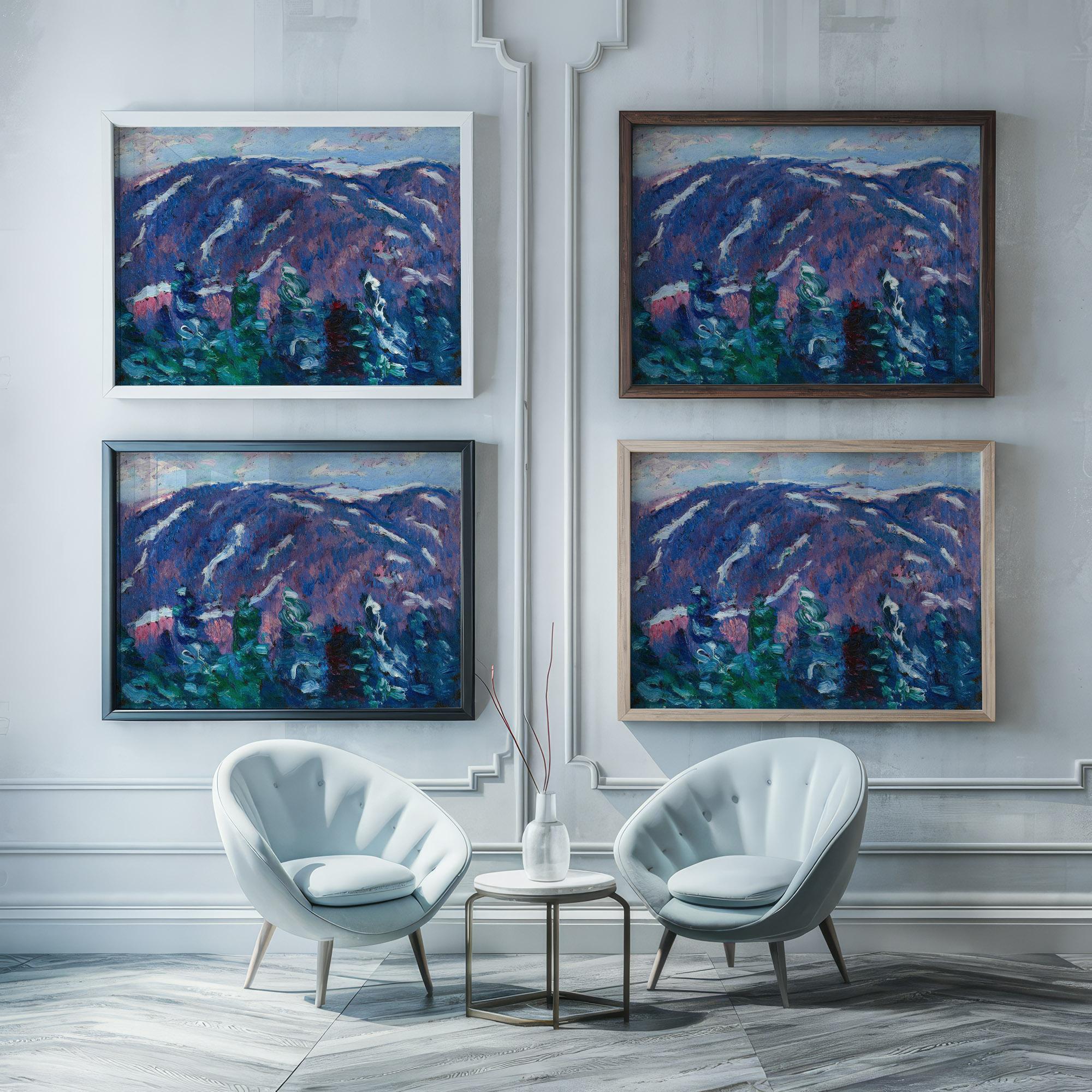
Hartley’s Songs of Winter brings texture to cabins and reading corners.
Franz Marc and Wassily Kandinsky: winter in color
Not every winter picture needs to be white. In 1911 Kandinsky and Franz Marc formed the Munich group Der Blaue Reiter (The Blue Rider), and both treated color as a way to express feeling rather than describe nature. Marc’s A Bison in Winter (The Red Bison) (1913) sets a red animal against a cold landscape. It was painted three years before Marc was killed at Verdun in 1916. Kandinsky’s Study for ‘Winter No. II’ (1911) dissolves a snowy scene into bright patches of color, right on the edge of abstraction.
These two suit people who want the season without the grey: kids’ rooms, colorful living rooms and any space that already has a bold rug or sofa.
James McNeill Whistler: a winter evening in Venice
In 1879, after a libel case against the critic John Ruskin won him a single farthing in damages and left him bankrupt, Whistler went to Venice on a commission from the Fine Art Society to make etchings. He stayed about fourteen months. His Venice work avoids postcard views and looks at back canals and quiet squares. Campo Sta. Marta – Winter Evening (1879-1880) is soft, low in contrast and very restrained, a good match for a bedroom or a traditional room with muted walls.
Choosing the right size
Winter scenes are mostly pale, so they read lighter on the wall than their actual size. Go one size up from what you would choose for a dark painting. The same rules from our wall art size guide apply:
- Above a sofa: aim for about two-thirds of the sofa width. For an 84 in (213 cm) sofa, that means artwork around 56 in (142 cm) wide. A single 30×40 in / 75×100 cm Kirchner, or two 20×28 in / 50×70 cm prints side by side, fills that space.
- Above a bed: a queen bed is about 60 in (152 cm) wide, so look for 36-40 in (90-100 cm) of art. A pair of 24×32 in / 60×80 cm prints works well.
- Between windows or above a console: a 20×20 in / 50×50 cm square, such as the Malevich, usually fits a wall section 30-40 in (75-100 cm) wide.
- Hallways and narrow walls: 12×16 in / 30×40 cm or 16×20 in / 40×50 cm portraits of trees, such as Munch’s Rugged Trunks, keep the path clear while giving the eye something to rest on.
Our large wall art size guide goes deeper on oversized pieces.
Hanging height and spacing
Hang the center of the artwork about 57-60 in (145-152 cm) from the floor, which is roughly eye level for most adults. Above furniture, leave 8-10 in (20-25 cm) between the top of the sofa or headboard and the bottom of the frame. For a pair, keep 2-3 in (5-8 cm) between frames so the two read as one group. Our step-by-step guide to hanging wall art covers hooks, levels and walls that are hard to drill.
A white frame makes snow look brighter and works in Scandinavian rooms with pale floors. Natural wood adds warmth, which suits Hartley and Kirchner and any cabin-style room. Dark wood or black frames give contrast and suit graphic scenes like Munch’s tree trunks or the Malevich. All WallArtK frames come with shatterproof plexiglass and hanging hardware, so they arrive ready to hang.
Styling ideas by room
Living room. Use one large horizontal snow scene as the anchor and keep the rest of the wall empty. Pick up one color from the painting, such as Kirchner’s pink or Malevich’s red, in a cushion or throw. For more ideas, see how to choose wall art for a living room.
Bedroom. Soft, low-contrast scenes are best here: Whistler’s Venice evening or Munch’s Field in Snow. Avoid stormy pictures above the bed. Our bedroom wall art ideas have more pairings.
Entryway. A winter print by the front door sets the season for anyone coming in. A narrow vertical piece at 16×20 in / 40×50 cm is usually enough.
A winter gallery wall. Group three to five snow scenes in matching frames: one large horizontal piece in the center, with smaller squares and verticals around it. Keep the palette tight (white, grey, one accent) so the wall feels like a series, not a jumble. Our complete gallery wall guide explains layouts and spacing. A pale snow wall can also open up a small room; see wall art that makes a room look bigger.
Keep winter art up past the holidays
The best part of a winter landscape is that it does not expire on January 1. A snow scene by Kirchner or Munch is a landscape first and a season second. Hang it in November, and it will still look right in a grey February, when the room needs light the most. In spring, swap it for a floral print and store it flat until next winter.
Every WallArtK print is a giclee on 250 gsm acid-free fine art matte paper, available unframed or in natural, dark, white or black wood frames.
Bring the light of a snowy morning into your home.