
Abstract Art for Beginners — What It Means & How to Choose
Title Tag: Abstract Art for Beginners — What It Means & How to Choose | WallartK
What Is Abstract Art, Really?
Abstract art doesn’t try to look like anything specific. There are no recognizable landscapes, no portraits, no bowls of fruit. Instead, abstract art uses color, shape, line, and texture to create visual experiences that exist purely for their own sake.
That definition makes some people nervous. “If it doesn’t look like anything, how do I know if it’s good?” That’s the wrong question. The right question is: “Does this piece make me feel something?”
Abstract art bypasses your analytical brain and speaks directly to your emotions. A swirl of deep blue might evoke the ocean without painting a single wave. Bold red geometric shapes might feel aggressive or passionate — depending on you, the viewer. That personal interpretation is the whole point.
A Brief History (30 Seconds)
Abstract art emerged in the early 1900s when artists decided they were tired of painting things that already existed. Wassily Kandinsky (1910) is often credited as the first purely abstract painter. Piet Mondrian reduced everything to grids and primary colors. Jackson Pollock threw paint on canvases on the floor. Mark Rothko created vast fields of color that seem to breathe.
Each movement — Cubism, De Stijl, Abstract Expressionism, Minimalism — took a different approach to the same question: what happens when you remove recognizable subjects from art?
The Main Styles of Abstract Art
Understanding the major styles helps you identify what resonates with you.
Geometric Abstraction
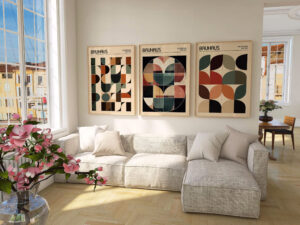
Clean lines, circles, squares, triangles. Think Mondrian’s grids, Malevich’s black square, or any piece that looks like it was made with a ruler and compass.
Best for: Modern, minimalist, Scandinavian, and mid-century interiors. Geometric abstract art adds structure and order to a space.
Mood: Calm, intellectual, precise.
Abstract Expressionism
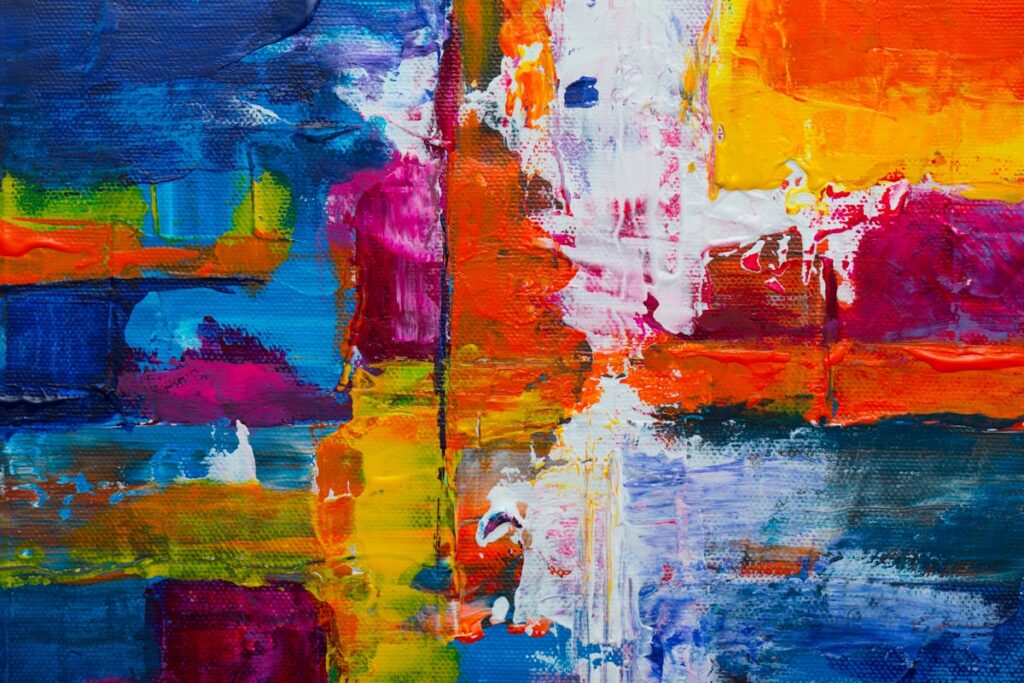
Big, emotional, gestural. Think Pollock’s drip paintings, Rothko’s color fields, de Kooning’s violent brushstrokes. These pieces feel raw and energetic.
Best for: Living rooms and offices where you want a focal point. Large-scale expressionist pieces command attention.
Mood: Passionate, intense, contemplative.
Color Field Painting
Large areas of solid or subtly gradated color. No lines, no shapes, just vast expanses of hue that create an immersive experience.
Best for: Bedrooms and meditation spaces. Color field art is calming and meditative.
Mood: Serene, spiritual, expansive.
Fluid Abstract
Organic, flowing shapes that mimic natural patterns — water, smoke, marble, galaxies. Often created with pour techniques or digital tools.
Best for: Any room that needs softness and movement. Fluid abstracts work beautifully in bathrooms, bedrooms, and hallways.
Mood: Dreamy, organic, flowing.
Minimalist Abstract
Stripped-down compositions — sometimes just a single line on a white background, or two colors in simple interaction.
Best for: Small spaces, gallery walls, contemporary interiors. Minimalist abstracts are easy to live with and never feel heavy.
Mood: Quiet, refined, contemplative.
How to Choose Abstract Art for Your Home
Step 1: Start With Emotion, Not Color
Forget about matching your sofa. Ask yourself: how do I want this room to feel?
Step 2: Consider Scale
Abstract art needs room to breathe. A tiny abstract piece on a large wall looks lost. A massive piece in a cramped hallway overwhelms.
Rules of thumb:
Step 3: Think About Color Temperature
Abstract art’s colors will influence the entire room’s feel:
You can either complement your existing palette (blue room + blue abstract) or contrast it (neutral room + one pop of red abstract).
Step 4: Choose Your Frame
The frame changes everything:
Step 5: Trust Your Gut
Here’s the secret art galleries don’t tell you: there is no objectively “good” or “bad” abstract art for your home. There’s only what moves you.
If a piece stops you mid-scroll, makes you look twice, or creates a feeling you can’t quite name — that’s the one. Don’t overthink it. Don’t worry about whether it’s “real art.” Your walls, your rules.
Common Mistakes When Buying Abstract Art
Mistake 1: Playing it too safe. If you’re drawn to bold abstracts but choose a “safe” beige piece to match your walls, you’ll regret it within a month. Art should elevate a room, not disappear into it.
Mistake 2: Ignoring scale. The most common error is buying art that’s too small. When in doubt, go bigger.
Mistake 3: Matching everything. Your art doesn’t need to match your curtains, your cushions, and your rug. Some intentional contrast creates visual interest.
Mistake 4: Hanging too high. Art should hang at eye level — meaning the center of the piece should be approximately 150cm from the floor. Most people hang art too high.
Mistake 5: Overthinking. Spending three months “researching” abstract art is procrastination. Find something you love, order it, hang it. You can always rotate pieces later.
Building a Collection
You don’t need to be wealthy to own abstract art. Here’s how to start:
Start small. One piece in your most-used room. Live with it. Notice how it makes you feel every time you walk past it.
Mix styles. A geometric piece in the hallway, an expressionist piece in the living room, a color field in the bedroom. Different moods for different spaces.
Support living artists. Original art from emerging artists costs less than you think and comes with a story. WallartK works with independent artists who create original abstract designs you won’t find anywhere else.
Rotate seasonally. Some collectors swap art with the seasons — warm tones in winter, cool tones in summer. It keeps your space feeling fresh without redecorating.
Abstract Art at WallartK
Our abstract collection spans every style — from bold geometric prints to soft fluid compositions. Each piece is:
Whether you’re buying your first abstract piece or adding to a growing collection, we make it easy to find art that speaks to you.
Explore Abstract Art for Your Space
Abstract art thrives on personal interpretation — the best piece is the one that moves you, regardless of what anyone else sees in it. Here’s how to find yours:
- Browse our full abstract art collection — curated in styles from geometric to expressive to minimalist
- Need sizing guidance? Our large wall art size guide walks you through choosing the right proportions for any room
- Thinking about a gallery wall with mixed styles? Our gallery wall guide shows you exactly how to arrange abstract pieces alongside photography and prints
- Or explore floral prints and landscape photography for contrast pairings that bring abstract art to life
Abstract art doesn’t ask you to understand it. It asks you to feel it. Start browsing — and trust your gut.
[Browse our abstract collection →]
Related articles: How to Choose Wall Art for Your Living Room, Gallery Wall Ideas, Wall Art Trends 2026